
Enhancing Your Business With the Power of AI
October-1-2025 by GLI Content Team in News
Share on Twitter,
LinkedIn
Updated: October 1, 2025
In today’s breakneck business environment, staying ahead isn’t optional—it’s vital. Advances in artificial intelligence continue to reshape the terrain, turning once-futuristic capabilities into practical tools for speed, creativity, and automation. From writing and research to image and video generation, AI is now deeply entwined with how work gets done.
What Is AI and Where Does It Stand in 2025?
At its core, artificial intelligence (AI) refers to systems designed to perform tasks that typically require human intelligence, including reasoning, perception, language, creativity, and more. Over the past decade, that definition has expanded dramatically. Today’s leading models go beyond text, integrating vision, audio, and multi-step reasoning to deliver more contextual and capable support.
ChatGPT and the New Frontier of AI Agents
The name ChatGPT still dominates the public perception of AI, but the platform’s capabilities now extend far beyond simple Q&A or content generation.
GPT-5 and Reasoning
In August 2025, OpenAI launched GPT-5, its next-generation model that emphasizes stronger reasoning, better alignment, and more accurate multimodal understanding.
It can interpret diagrams, charts, and images more reliably, not only describing them but also drawing inferences from them.
For example, you could feed GPT-5 an architectural blueprint and ask it to detect structural inconsistencies, or supply a series of slide images and have it summarize the argument flow.
That said, the rollout was not without controversy. Users have reported glitches, ambiguous interface changes, and confusion about model routing. In response, OpenAI reinstated prior models, such as GPT-4o for paid users, while addressing bugs.
Agents (Deep Research) and Task Automation
Another key development is the introduction of Deep Research, an AI agent integrated into ChatGPT that can browse the web autonomously for 5-30 minutes to generate cited, expert-level reports on user-specified topics.
Meanwhile, OpenAI continues pushing toward more tool-enabled agents. These AIs can take actions on your behalf, such as querying APIs, filling in forms, or chaining steps of logic across modalities. For industries with customer service call centers, such as self storage, AI Leasing Agents can answer every inquiry and check real-time inventory so your team doesn’t lose leases due to missed calls.
Commerce, Video, and the Wider Platform
ChatGPT is evolving beyond a mere conversational interface. In 2025, OpenAI introduced Instant Checkout, allowing users to purchase items directly from Etsy (and soon Shopify) during a chat. This move transforms ChatGPT into a commerce hub rather than a passive assistant.
Additionally, OpenAI launched Sora, a video generation app that enables users to create short AI-powered videos from copyrighted content, provided that rights holders don’t opt out.
The upgraded Sora 2 can now generate video with audio (speech, sound effects) and avatar insertion capabilities. This extension into video marks the next frontier for AI-generated content.
Midjourney: Revolutionizing Image Generation

One fascinating facet of AI is its ability to generate completely new images. Midjourney has emerged as a leading innovator in this field, leveraging AI to create environments, objects, and even human-like figures with remarkable accuracy. This capability enables users to generate a diverse array of artwork and designs in a matter of minutes.
Midjourney’s image generation technology marks the first step towards integrating AI image models into the digital workspace, competing with traditional stock images. It can save you time searching through stock databases, create images that you won’t be able to find in stock databases, and offer faster generation speed and more distinctive compositional styles. However, Midjourney does not fully replace stock images, as Midjourney can create impossible objects and distorted features.
The Versatility of Midjourney

Midjourney provides users with a range of AI models to suit their image generation preferences. If you desire realistic and cinematic visuals, Midjourney version 5.2 excels in creating lifelike images and immersive environments. On the other hand, if you seek creative and cartoonish styles, Midjourney’s niji model offers the ability to replicate near-limitless artistic possibilities.
Accessing Midjourney and Creating Images
To access Midjourney, users can join the official Midjourney server on Discord. Simply sign up for a Discord account and follow the provided invite link. Once you have set up your Midjourney account and joined the server, explore the various image-generation channels to unleash your creativity. It is important to note that an active subscription account is required to use Midjourney’s image generation capabilities.
Creating images with Midjourney is straightforward. By using the “/imagine” command, users are provided with a text box to enter their prompts. This is where your imagination takes flight. Describe what you want the AI to generate, and witness the image come to life before your eyes.
The prompts can be modified using an array of creative styles, allowing customization of elements such as colors and the ability to mimic the styles of famous artists. Experimentation through trial and error and by tweaking parameters and styles is recommended to achieve the best results. Comprehensive documentation on styling and prompting can be found at Midjourney’s quick start guide.
Mastering the Art of Prompting

Prompting is a text, question, or information communicated to the AI in order to achieve a desired goal. The art of prompting is essential when working with AI models. In the context of Midjourney, your prompt is simply a description of what you wish to see. While simply describing what you want generated can yield results, understanding how to craft effective prompts is critical to achieving optimal outcomes. Through careful consideration of the desired image and providing clear instructions, users can maximize the AI model’s understanding and generate more accurate and tailored results.
Midjourney’s image generation process follows a three-part structure, providing flexibility and customization options for users. Initially, a basic prompt outlines what you want to generate, such as a “watercolor painting of a cat.” However, advanced prompting techniques can take it further by incorporating parameters or additional reference images for Midjourney to consider during the generation process. For a visual demonstration, please refer to the advanced prompts link.
Styling and Parameters
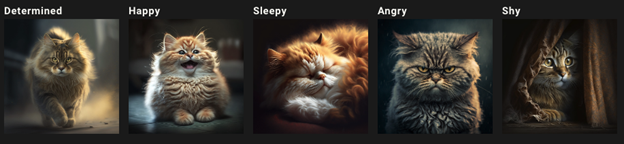
Parameters play a crucial role in refining prompts and obtaining optimal results. Midjourney offers various parameters like “–style” or “–chaos” that can fundamentally alter the AI’s image generation approach. These parameters allow you to quickly modify the AI model or exclude specific aspects of the image using the “–no” command. To utilize these parameters, simply add them to the end of your prompts, as shown in the official parameter list.
Styling is a vital aspect of effective prompting. The more descriptive you are about the desired style, colors, and composition, the more fascinating the generated results can be. To ensure the AI’s understanding aligns with your vision, your prompts must be as detailed as possible. Remember that leaving any aspect unsaid may lead to unexpected surprises in the generated image. If you seek a more accurate result, it is advisable to avoid using niche or uncommon ideas and instead focus on common concepts.
To infuse your generation with a particular style, consider mentioning a specific piece of artwork or artist whose style you would like the AI to emulate. This can result in intriguing and personalized outputs. Additionally, introducing emotions to your prompts, such as requesting a “sense of excitement,” can significantly influence the generated image, evoking the desired mood or atmosphere.
By following the three-part structure, utilizing parameters effectively, and providing detailed instructions for styling, you can enhance the quality and creativity of your prompts when using Midjourney’s image-generation capabilities.
AI Applications in the Workplace

Many businesses have already embraced AI tools like ChatGPT to streamline their operations. Integrating AI-powered text and image generation models into the workplace can further enhance efficiency and productivity. These AI tools automate repetitive tasks, reducing manual labor and freeing up valuable time for employees to focus on more complex and creative aspects of their work.
AI-powered tools can generate high-quality images, write persuasive ad copy, draft engaging articles, and maintain consistency with predefined brand guidelines. By leveraging AI, businesses not only keep up with the fast-paced work environment but also outpace it.
Exploring AI Models
Free and premium options exist for those looking to venture into the AI scene with limited investment. Free AI models like ChatGPT and Google Bard offer exceptional text generation capabilities. Regarding image generation, Midjourney stands out in terms of quality and speed. However, alternative models such as Dall-e/Nightcafe also exist, each with varying degrees of quality and pricing. It is essential to conduct thorough research to determine the best AI solution that aligns with specific needs and budget considerations.
The Importance of Adaptation in an Ever-Changing Workplace
The past few years have shifted us from “AI as novelty” to “AI as infrastructure.” Tools like ChatGPT, Midjourney, and Sora are now building blocks in enterprise operations, not just shiny side experiments.
Adapting to this new era means:
- Becoming fluent in multimodal prompting
- Integrating AI agents as teammates, not just tools
- Closely monitoring ethical and legal boundaries
- Choosing stacks thoughtfully to balance power, cost, and risk
- Leading the change by encouraging experimentation inside your team, while anchoring it with safeguards
In this age of rapid AI evolution, the first adopters and smart integrators will define the competitive edge. Those who align creativity, productivity, and guardrails will lead, not just follow.
More Case Studies & Blogs

How a social media strategy doubled visibility, generating a 50% increase in online conversions and sales.


Let’s Work Together.
Get the best out of your digital marketing efforts with an expert agency. Contact us and let's get started driving success together.